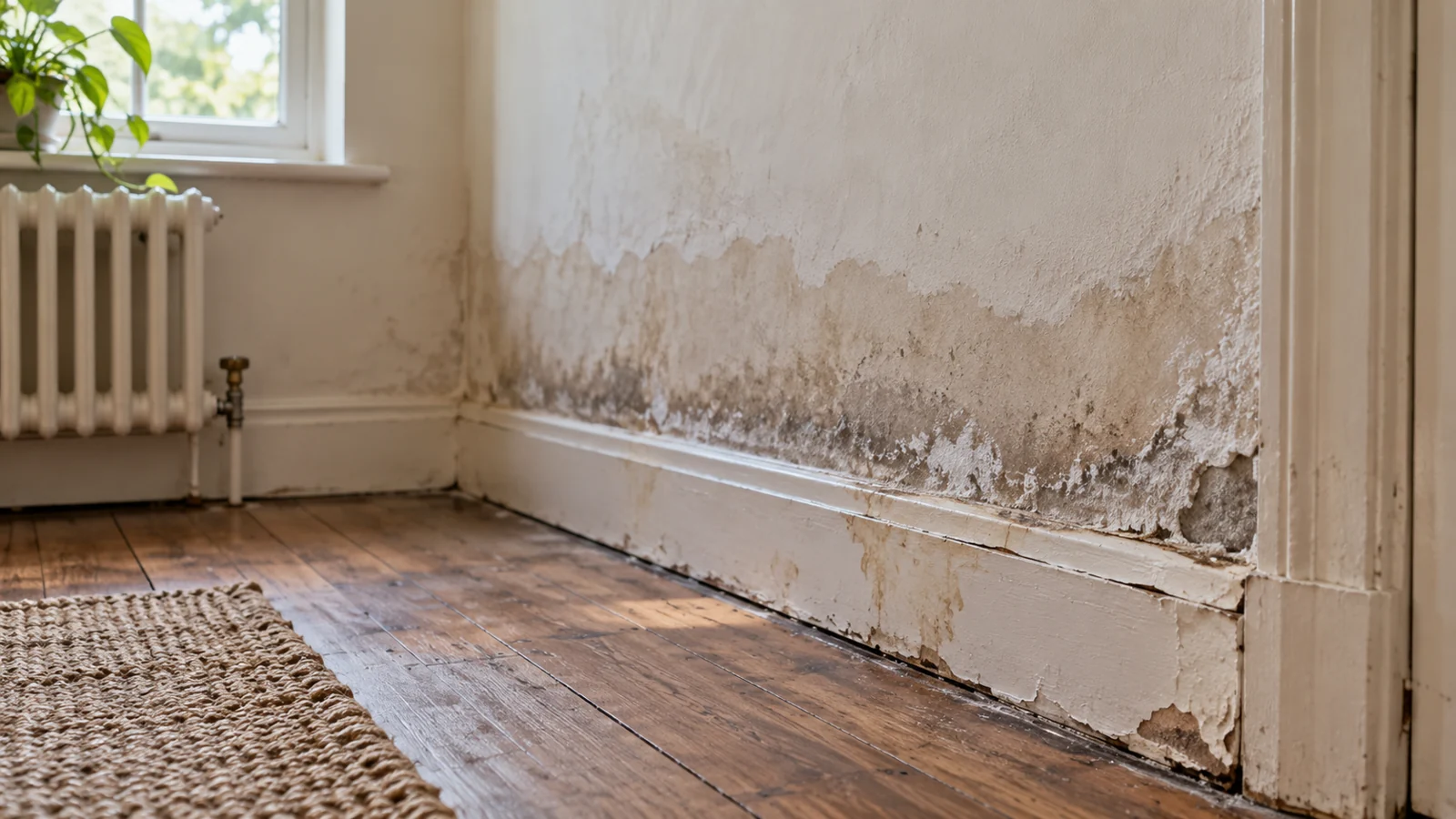
Rain gives an important clue
Damp that becomes noticeably worse during or shortly after rain points towards rainwater entry, although the exact route may be concealed. Water can travel along cavities, timbers or plaster before appearing some distance from the original defect.
Look above and beside the patch, not only directly opposite it outside. Water may enter around a chimney flashing or cracked render, move along a cavity or roof timber, then appear some distance away. Photograph marks after storms and note the wind direction.
If damp appears after wind-driven rain on one elevation, inspect the exposed masonry, window perimeter, roof junctions and pointing. Avoid assuming that every rain-related mark means porous bricks need sealing.
Follow the wall upwards
Look at gutter joints, downpipes, parapets, coping stones, chimney flashings, roof junctions and cracks around window openings. Inspect safely from the ground or use a suitable contractor. Do not lean out of windows or climb onto a wet roof.
Check the ground outside
Rainwater may accumulate against walls where paving falls the wrong way, gullies overflow or soil levels are high. Splashback can soak the lower courses of brickwork. Look for evidence of standing water after a downpour.
Overflowing gutters and defective downpipes can soak walls repeatedly. Blocked gullies may leave water ponding against the base of the building. A raised patio or path can also encourage water towards an opening or bridge a damp-proof course.
Have safely accessible defects checked first. Never climb a wet roof or ladder to inspect suspected leaks during a storm.
Understand cavity walls
Water entering the outer leaf does not always reach the inside. However, cavity debris, failed trays, defective pointing or poorly sealed openings can create a path. Simply painting the outside with a water-repellent coating may mask, rather than solve, the defect.
Avoid guessing from a stain
A stain on a bedroom wall might come from a slipped tile or flashing above, while a patch near a skirting board might result from an overflowing gully. Location matters, but the nearest visible defect is not necessarily the source.
Water-repellent coatings may be suitable in particular designs, but applying one without identifying an entry path can leave the defect unresolved and may alter evaporation. Repointing with a hard cement mortar can also be inappropriate for some older walls.
A targeted repair supported by a proper inspection is generally preferable to treating a whole elevation simply because a small patch appears indoors.
Repair and monitor
Record photographs and weather conditions, repair the identified defect and allow for drying. Plaster may remain stained after the leak has stopped. If water is active near electrical fittings or ceilings are bulging, seek urgent professional assistance.
It can be helpful to inspect the same area on a dry day and again after heavy weather. Look from ground level for signs such as staining beneath gutters, missing mortar or splashback from paving. Indoors, mark the outline of a stain lightly on a photograph instead of on the wall. Compare it with the timing of rainfall. A stain may keep spreading for a while after rain stops as moisture travels through the building fabric. The delay is one reason leaks can be difficult to trace.
Keep dated photographs and notes of any changes. They can be useful when explaining the issue to a surveyor or contractor. If there is active water near electrics, an unstable ceiling, or a floor that appears unsafe, arrange prompt professional help rather than waiting to see whether the problem improves.
Need help from a local damp specialist?
Look for a suitable local professional and explain the symptoms clearly. You can use an external trade-matching service to request quotes; check credentials and the proposed diagnosis before agreeing to work.
Find local tradespeople on MyJobQuote →Opens MyJobQuote. DampUK is an information website and does not select or endorse individual contractors.